Wednesday, November 2, 2016

Political unrest hits Ethiopia FDI

Violent protest could spell the end of Ethiopia’s impressive upward economic trend.
Anti-government protests in Ethiopia have been reignited after 55 people were killed at a festival-turned-protest in early October. Widespread demonstrations followed and foreign businesses have become symbolic targets for anti-government protest. A six-month state of emergency now prevails, alongside a plethora of tough counter-measures.
An estimated 24 foreign companies have suffered millions of dollars in damage this October, according to UK-based consultancy Verisk Maplecroft. News site AllAfrica reports that 11 factories have been burned and seven foreign-owned flower farms damaged, such as AfricaJuice, which employs 2000 people.
The violence follows a wave of unrest that began last November among the Oromo, Ethiopia’s biggest ethnic group. Originally, protesters railed against the government’s plan to expand Addis Ababa into surrounding Oromo lands. However, their demands have escalated to include broader reforms, not least because 500 people have been killed by security forces since last year, according to Human Rights Watch.
The Oroma claim they are politically and economically marginalised. The People’s Revolutionary Democratic Front (PRDF), dominated by the Tigray minority, has ruled since 1991 and maintained an ambitious economic programme that relies heavily on FDI. Ethiopia’s GDP growth has been exemplary, averaging nearly 10% since 2004, according to the World Bank.
However, industrialisation has been crudely implemented, with Oromo and Amhara land being a prime target. Protesters contend that they have received scant compensation for their displacement and benefited very little from the country’s stellar GDP growth.
For their part, foreign investors have reaped more obvious rewards and privileges as the government “attracts FDI by providing land and services cheaply”, says Awol Allo of the law department at the UK’s Keele University. Foreign investors have thus been increasingly targeted, especially of late.
The US has issued travel warnings, while the PRDF is limiting the movement of foreign nationals, because a US citizen was killed recently during a protest, possibly by accident.
Dutch company Esmeralda Farms and a US-owned farm have already pulled out of Ethiopia. “The government is rattled by the prospect of capital flight,” according to The Economist, and the state of emergency is “an attempt to reassure foreign investors [that] security is under control”.
However, although tough counter-measures such as arbitrary arrests and press limitations have restored stability in the past, the US government fears that the scale and nature of this episode may render such tactics “counter-productive” if grievances are not addressed.  
Fitch Ratings states that “the key near-term risk from the unrest is… in particular, lower FDI.” According to greenfield FDI tracker fDi Markets, the number of greenfield investment has significantly fallen since last year. In 2016 to date, Ethiopia has secured only nine projects, while this time last year it reported 25 and in 2014, 31.
More worryingly, Ethiopia’s main sources of FDI – the US, South Africa, India, Turkey, the UAE, Germany and the UK – have not undertaken any greenfield investment since November 2015, an unusually long but unsurprising interval.
Contrastingly, the latest greenfield investment from China, Ethiopia’s second largest source of FDI, was in July 2016. This reflects China’s commitment to increased outward investment – specifically the One Belt, One Road project – as does the recent completion of the $3.4bn Chinese-built railway between Ethiopia and Djibouti.
For some, this is more evidence of China’s geopolitical gains in Africa, while some see the west as floundering.
The PRDF has fallen back on geopolitics to explain the recent unrest. It accused “foreign enemies”, namely sub-state Egyptian and Eritrean groups, of “arming, financing, and training those elements” intent on violence, terrorism and unrest, that is, the protesters.
As it stands, the Ethiopian government is keeping a lid on the cauldron. However, this time there is a sense that, should grievances remain unaddressed,  instability could ensue and, with it, the ironic loss of PRDF’s prized FDI. 

FDI Intelligence

Ethiopia Unrest Worries Foreign Investors


FILE - Demonstrators chant slogans and flash the Oromo protest gesture during Irreecha, the thanksgiving festival of the Oromo people, in Bishoftu town, Oromia region, Ethiopia.
In Ethiopia, millions of dollars in investment went up in smoke as protesters attacked foreign companies in the Oromia region. The violence prompted the declaration of a state of emergency last month. But one foreign company managed to stave off an attack with the help of community elders.
Since he came to Ethiopia 13 years ago, the owner of Maranque Plants, Marc Driessen, had never feared for the future of his company, located about 80 miles south of Addis Ababa.

But that changed on October 4. Driessen saw several neighboring companies in flames. The noise of the mob was growing louder and he knew his company, where he grows cuttings for export, was next.
Marc Driessen is the owner of Maranque Plants and narrowly escaped an attack by an angry group of Ethiopian protesters, Oct. 4, 2016, in the Oromia region, Ethiopia.
“We saw the protesters here in front of the gate, with sticks and knifes. And it was really frightening to see them come this way,” he said.

Anti-government demonstrations started in the Oromia region a year ago, but it was only recently that protesters also turned against foreign-owned companies.

More than ten foreign companies have been attacked since September. Protesters say the government gives land to foreign investors without proper compensation for smallholder farmers who are forced to vacate their land.
Workers at Maranque Plants are harvesting the cuttings produced for export in the Oromia region, Ethiopia.

Maranque Plants employs 1,200 people, mostly women. Buziye Mekonnen is one of the many harvesters there. Throughout the day, friends and family called her to warn protesters could attack.

Buziye and the other women were sent home. But Buziye was still scared, as her husband also works at Maranque Plants.

She said they were scared from the moment they heard another company was burned down. And what would they do, she asked, if this company was burned down because then there would be no other job opportunity for them.
Buziye Mekonnen is a harvester at Maranque Plants. On the day of the attack she was sent home but feared for the future of her employment.


Despite having one of Africa’s fastest growing economies over the past decade, unemployment in Ethiopia is high and over a quarter of the population is living below the poverty line.

As nearby farms were being burned and looted, Driessen got lucky. Community elders arrived at his gate on motorbikes. They spoke to the angry crowd.

Community elder Shumi Telila said he told the protesters they should not burn the place as their issue was about good administration and not with the company.
Community Elders Shumi Telila (left) and Ahmed Hamda (right) intervened when protestors were about to attack Maranque Plants, a foreign owned company, Oct. 4, 2016, in the Oromia region, Ethiopia.


Telila said since then, the elders have stayed in touch with Driessen and community members to discuss issues.

Some in Ethiopia worry the unrest will stall the foreign direct investment that has fueled the nation's growth. 

Production at Maranque Plants is now back to normal, but Driessen said he is still afraid the turmoil is not over.

“We have talked with our clients about what we are going to do in the coming months and what we did is that the unique varieties that are produced by us are also now going to be produced in Uganda so that our clients can maintain their continuity in case of problems," said Driessen.
Production is back to normal at Maranque Plants in the Oromia region, Ethiopia, after being almost attacked by protesters on Oct. 4, 2016.


No foreign companies have been attacked since the government declared a 6-month state of emergency October 9. The government said this week that it released about 2,000 people detained over the violence.

Ethiopia’s government said it will do whatever it takes to restore confidence for foreign investors.

But rights groups and opposition leaders warn that addressing protesters’ grievances is the only way to stabilize the country in the long term.

VOA

New Ethiopia Opposition Coalition Envisions Regime Change


WASHINGTONNov. 2, 2016 /PRNewswire/ -- The Ethiopian National Movement (ENM) was launched on Sunday, October 30, after months of negotiations among four political parties that formed the coalition to lead and coordinate the struggle of the Ethiopian people for justice, freedom and democracy.
Formed by the Patriotic Ginbot 7 Movement for Unity and Democracy, Oromo Democratic Front, Afar People's Party and Sidama People's Democratic Movement, ENM strongly condemns the killings, mass incarcerations and atrocities being committed against innocent civilians. It believes that the unjust rule of the brutal minority regime, which has declared a state of emergency to crush popular demand for change, is no longer sustainable.
ENM strives to create a peaceful transition in Ethiopia on the tombs of the dictatorial Tigrian minority regime, which has been inflicting unimaginable sufferings on the people of Ethiopia. The coalition also urges the U.S. Government and other Western countries to work with agents change such as EMN instead of providing unconditional aid to a regime that is terrorizing its own people.
EMN envisions a truly federal democratic system that respects human, political and civil rights of all Ethiopians.  ENM firmly believes in the necessity of creating a peaceful transition to enable citizens fully exercise their rights and create an all-inclusive government through a democratic process.
The coalition is in negotiation with other opposition political groups in a bid to create a larger and broad based movement for democratic change.
To introduce its program as well as its visions, missions and strategies to hasten radical political and socio-economic changes in Ethiopia, leaders of ENM and leading activists will hold a press conference at the National Press Club, 529 14th Street NW Washington, DC 20045
Venue: 13th Floor, First Amendment Lounge
Date: Friday, November 4, 2016
Time: 12:15 pm-2:30 pm
Speaking at the conference and available for one on one interview afterwards are:
Mr. Lencho Leta--ODF President and co-chairman of the Council of Representatives (CR) of EMN
Dr. Dima Nogo--ODF Vice President and Chairman of the Executive Council (EC) and General Secretary of ENM's Council of Representatives
Dr. Kontie Moussa--Chairman of the Afar People's Party and Founding Member of the Ethiopian National Movement
Mr. Muluneh Eyoel--Member of the Leadership of Patriotic Ginbot 7 Movement for Unity and Democracy - Founding Member of the Ethiopian National Movement
Mr. Bekele Wayu--Chairman of the Sidama People's National Democratic Movement - Founding Member of the Ethiopian National Movement
Mr. Haile-Gebriel Ayalew--Observer-based on a special arrangement to have unofficial representation for the Amhara people's voice in the formation of the National Ethiopian Movement
Award-winning activist and journalist Reeyot Alemu, is a producer with the Ethiopian Satellite Television and Radio, ESAT. She was unjustly jailed for four years under trumped-up terrorism changes for being a vocal critic of the regime, one of the top-five jailers of journalists in the world. Reeyot won, among others, the UNESCO/Guillermo Cano World Press Freedom Prize in 2013 and the International Women's Media Foundation's Courage in Journalism Award in 2012.
Media requests and further information:
zewdieg@gmail.com 
Tel. 240 205 1192
PR Newswire

Tuesday, November 1, 2016

Ethiopia: Important Cabinet Reshuffle Amid Tensions


Photo: Tiksa Negeri/Reuters Media Express

Demonstrators chant slogans while flashing the Oromo protest gesture during Irreecha, the thanksgiving festival of the Oromo people, in Bishoftu town (file photo). The new cabinet has several Oromo members, and it is being seen as a response to the protests
By Sebastian Satigui
Addis Ababa — Prime Minister Hailemariam Desalegn appeared today before parliament in Addis Ababa to present his newly restructured administration.
A large number of the new ministers are making their first entry in government, and have no direct party affiliation. They are viewed as technocrats chosen exclusively on the basis of their competence called to serve the nation and not the interest of the governing coalition, EPRDF. It is worth noting that no less than 8 Oromos have joined the new cabinet.
The Oromo region has been the center of the protests that have elevated the tensions around the country. Among top party officials leaving the government are Dr. Tedros Advance, minister of foreign affairs, who is the continent's candidate to head the World health organization, Redman Hussein, minister of youth and sports, and Getachew Reda, minister of government communications.
Many in Addis Ababa view the significant cabinet reshuffle as a response to the current and unprecedented crisis that led to the declaration of a nationwide state of emergency on October 8, 2016. In a sign of detente, some 2,000 Ethiopians arrested as part of the State of emergency were released yesterday.
Upcoming weeks will be crucial in establishing whether or not the reshuffle has helped ease the situation in Oromo and Amara regions

All Africa

Ethiopia’s state of emergency: both sides are determined to fight to the finish

The state of emergency in Ethiopia is the last attempt by the Tigrayan-led regime to stop the Oromo and Amhara protests and maintain political power.
Asafa Jalata describes how the demands of the Oromo people, and others who believe they are marginalised, are being met with increased violence and repression by the state. Tiksa Negeri/Reuters

Waves of protests have gripped Ethiopia since last November . In response the government has declared a six-month state of emergency . In an interview with The Conversation Africa’s Samantha Spooner, Asafa Jalata describes the impact of the state of emergency and what it could mean for the future of the country.
Who are the main players and what are the main grievances of the Ethiopian protest movement?
The Oromo protest movement emerged in November 2015. It has been fomenting for decades because the Oromo consider themselves colonial subjects . They are the largest ethnonational group in Ethiopia and have been denied equal access to their country’s political, economic and cultural resources.
For almost 25 years Tigrayan state elites have dominated different structures of the government, including the military. They have also had total control over other institutions such as the media. And they have confiscated fertile land and other valuable resources such as gold and other minerals.
Over the last few months, the protests spread across the country. Other ethnonational groups, which also feel politically and economically excluded by the Tigrayan-led minority government, have also joined the movement.
The Amhara, the second largest ethnonational group, started to protest peacefully against the Tigrayan-led minority government in August this year. They expressed their grievances and support for the Oromo protests in the Amhara regional state. Other ethnonational groups, known as the Konso, Sidama, and Gedeo joined more recently.
The protests gained further traction as the state’s reaction became violent. For example, in early October millions of Oromo gathered at Hora Arsadii, south-east of Addis Ababa, for Irreechaa - the Oromo national holiday of thanksgiving. The Tigrayan-led regime’s army killed more than 700 Oromos and injured hundreds. This was sparked by peaceful, anti-government chants by young Oromos.
After the massacre, Oromo protesters burned property and both locally and internationally owned businesses that had been built on the land seized from the Oromo by Tigrayan state and business elites.
The Ethiopian regime’s response was to declare the state of emergency. Set to last six months, its aim is to curb the growing anti-government protest movement.
What impact has this state of emergency had on the various communities in the country?
The current state of emergency is the last attempt by the Tigrayan-led regime to stop the Oromo and Amhara protests and to stay in power. The government is, therefore, using this situation to gain total control over information, use heavy force and deny the freedom of organisation and association.
As a result, the regions of Oromia, Amhara, Ogaden, Konso, and Gedeo have become conflict zones with the regime indiscriminately imprisoning, looting and killing protesters.
According to the state of emergency rules, Oromos, Amharas and Konsos have restricted access to media. They are not allowed to listen to radio stations, such as the Oromo Voice Radio, or to watch media channels, like the Oromia Media Network. Ethiopian soldiers are enforcing these rules and have been seizing or breaking satellite dishes.
The emergency rules also prevent citizens from associating with political organisations that the regime has branded as “terrorist”. One of these is the Oromo Liberation Front which was established in 1973 by Oromo nationalists to promote self-determination.
The situation for the Oromo people is dire. For several months the region has been under a crackdown enforced by special police groups and the army known as “Agazi”. According to rights organisations, more than 2 000 Oromos have been killed in eleven months. Several thousand more have been imprisoned, tortured, blinded and raped.
The rule of law no longer seems to apply to the Oromo and their supporters. To hide its crimes from the international community, the regime has blocked the internet and collected phones from thousands of Oromos.
Until the regime is overthrown they will continue to suffer immensely. They are being excluded from state support in relation to protection, food, shelter, clothing, medicine and other necessary services.
As a group is the Oromo community concerned about their future?
Because the current regime fears the size of the Oromo population, it tries to minimise their influence through hidden policies and war. The regime has already prevented Oromo representatives from coming into political power through systematic killings, imprisonment or exile. For these reasons, the Oromo are very concerned about their future.
In addition, little looks set to change as a result of external pressure because international powers such as the United States as well as organisations such as USAID have a close relationship with the regime. This gives rise to concerns within the Oromo community that their grievances will not be heard and that they will not be given support.
Nevertheless, the Oromo people are determined to change their status quo and better their future. That is why they continue with their movement, despite massive incidents of death and imprisonment.
What are the prospects for the government and leaders of the protest movement meeting to resolve the political issues between them?
Resolving the conflict requires the implementation of social justice and democracy. But the Ethiopian regime has demonstrated that it will dictate everything to the Oromo people and its leadership through the barrel of the gun.
The Oromo are rejecting this heavy-handed approach. So, in this conflict, there are two options – either the regime must go, and the Oromo be victorious, or the Oromo people must be destroyed to serve the interest of the regime.
Asafa Jalata, Professor of Sociology and Global and Africana Studies, University of Tennessee
This article was originally published on The Conversation. Read the original article.

Mail & Guardian Africa

Ethiopia's political crisis: Norway worried, calls for participatory politics

Ethiopia's political crisis: Norway worried, calls for participatory politics
Norway says it is concerned about the restive situation in the horn of Africa region in general but more so about Ethiopia. A “partner” suffering from political unrest resulting in a recently imposed state of emergency.
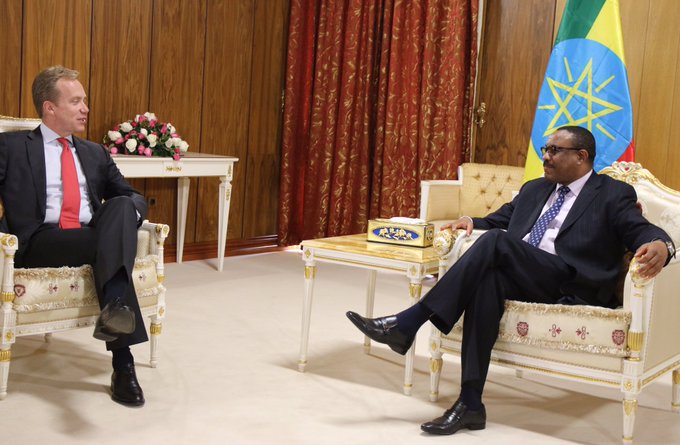
The Norwegian Foreign Affairs chief, Borge Brende, added that there was the need for the government to quickly undertake planned political reforms, an that they will be closely following the situation in the country.
‘Ethiopia is an important partner country for Norway, and has for a long time represented stability and development in an otherwise unstable region. I wish to continue our dialogue also in challenging times.
I am worried about the unrest and about the state of emergency which has now been introduced. It is important that the situation does not deteriorate. Half of Ethiopia’s 100 million citizens are young people who want jobs, freedom of expression and the opportunity to participate in politics,’ said Mr Brende.
Brende visited the Horn of Africa region between 25 – 29 October, 2016. He met government officials of South Sudan, Kenya, Somalia and Ethiopia. In the case of Ethiopia, he conferred with Prime Minister Hailemariam Desalegn.

Thanks for a good meeting with  PM Desalegn on regional & national issues: Security, development & 
·       
‘The region (Horn of Africa) is facing armed conflict, humanitarian crisis and political instability. It is in Norway’s interest to support measures which can contribute to stability and development,’ he said.
He bemoaned the situation in South Sudan where over five million people are suffering from humanitarian crisis since violence broike out in 2013. Somalia’s fight with al Shabaab insurgents and Kenya’s upcoming general elections were all of concern to Norway.
‘Norway is actively engaged in close dialogue with authorities in the Horn of Africa. We contribute with humanitarian aid and long-term development support, as well as business sector engagement where this is possible.
The region has great potential, but there are major political challenges and millions of displaced people who need a durable solution to their situation,’ Mr Brende added.
Norway and Ethiopia have broad cooperation on issues including climate, education and human rights.

Africa News

Ethiopia frees 2,000 protesters as hundreds seek amnesty

Demonstrators chant slogans while flashing the Oromo protest gesture during Irreecha, the thanksgiving festival of the Oromo people, in Bishoftu town, Oromia region, Ethiopia, October 2, 2016 (Reuters Photo)
By Tesfa-Alem Tekle
October 31, 2016 (ADDIS ABABA) – More than 2,000 individuals who were in jail following the recent violence have now been freed after taking the necessary corrective lessons, Ethiopia’s defence minister, Siraj Fegesa disclosed.
Siraj, who also sits at the Secretariat of the Command Post, said people believed to have been behind the recent unrest have peacefully surrendered to the government.
The suspects could be granted amnesty depending on the level of crimes they have committed.
Soon after the Horn of African country declared a state of emergency, its authorities called on suspects behind the deadly violence to turn themselves in.
The Ethiopian government imposed a six-month state of emergency on 8 October to restore order and contain violent protests in many parts of Oromiya and Amhara region.
While briefing journalists on Sunday the defence minster, said calm had been restored after the implementation of the state of emergency measure.
The suspects arrested, Fegesa said, had roles in the violence that hit the nation weeks back.
Some of the suspects, added the minister, had began surrendering to the Ethiopian government.
According to the official, at least 400 individuals peacefully surrendered to the command post before the 10-day amnesty ultimatum set the authorities.
He further said 1,500 illegal weapons were recovered from violence-prone areas after they collaborates with the public.
The suspects still in jail are taking corrective lessons in different training centers in Amhara and Oromia region.
Government officials and those at the state of emergency command post secretariat said the violence and unrest in parts of the nation have calmed down.
“Violence has been contained and we have created a situation where people can go about their lives without the fear of being attacked”, the communications minister, Getachew Reda, said.
He stressed that several investments and factories in the country were back to business and people are doing their normal activities safely.
Meanwhile, the State of Emergency Inquiry Board tasked to follow up and report the human rights handling by government while implementing the state of emergency decree has commenced its work.
The chairperson and members of the board said the inquiry board began exercising its authorization in accordance with the constitutional provision that sets out the specific duties and responsibilities.
Members of the board pledged to carry out their duties and responsibilities in a neutral way.
The declaration of a state of emergency imposed was in response to the series of protests in the two sensitive regions in which violence claimed hundreds of lives.
Directives of the decree among others, include authorising police to arrest individuals without a warrant, blocking internet access, prohibiting public gatherings and imposing curfews.
Diplomats in the country were not permitted to travel beyond 40 kilometres of the radius outside the Ethiopian capital, Addis Ababa.
Following the state of emergency decree, the United Nations urged government to ensure the protection of fundamental human rights when imposing the measure.

Sudan Tribune