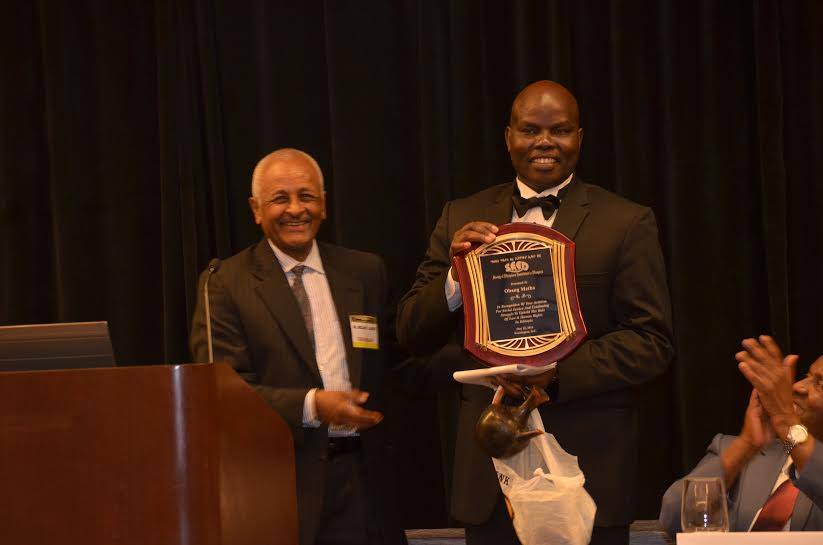
Mr. Obang Metho’s Acceptance Speech: At the 22nd SEED Annual Award ceremony
I would like to deeply thank distinguished members of the Society of Ethiopians Established in Diaspora (SEED) and my fellows’ citizens of Ethiopia for this recognition. I am both humbled and honored to be here tonight as a recipient of this award. I receive this honor with deep gratitude and great humility. I want to acknowledge others who have helped make this possible because, although I am accepting this award, this is not only about me. I did not come to this point alone, but must recognize the countless individuals, too many to name, who have contributed to this work along the way. Without them there would not be anything to acknowledge, just like the African proverb that says, “If you want to go faster, go alone, but if you want to go further, go together.” My thanks and appreciation goes to all of these people who have helped us go further. Our journey together has been one of many challenges, but because it has been shared, it has brought unexpected friendships, joys and fruit.
I was told that this award was in appreciation for the work done in defense of the freedom and civil rights of our people, especially, the under-represented Anuak. I am very emotionally touched by this statement, especially the inclusive phrase, “our people,” which embraces Anuak, as well as other Ethiopians, both mainstream and minorities, as part of the whole of people of Ethiopia. Do you realize how revolutionary this is? Ten years ago this never would have happened. It is an indication of a major paradigm shift in our thinking. It is a cornerstone of a New Ethiopia where humanity comes before ethnicity or other identity factors and where we care about our Ethiopian brothers and sisters because no one will be free until all are free! The journey has not been easy, nor is the journey over, but if we travel together, we will go further and possibly faster, than any of us expected.
This journey began on December 13, 2003, with a desperate phone call from Gambella, Ethiopia. A massacre of Anuak leaders had begun in Gambella, perpetrated by the TPLF/EPRDF Defense Forces, accompanied by civilian militia groups, incited and equipped by the military. Within three days, over 425 Anuak had been brutally killed in an effort to eliminate the strongest opposing voices to the extraction of possible oil reserves on Anuak indigenous land without first consulting the people.
When I first saw the names of those killed, I knew over 300 of the victims. They were family members, friends and colleagues in the development work I was carrying out in Gambella. As I grieved for the loss of their lives in the days and weeks that followed, I realized that the only option for a better future for the Anuak and the people of Ethiopia would not come from retaliation, but only from transformation to something better than the cycle of revenge we had seen played out in the past. Yet, despite this personal revelation, today’s reality of me standing up for the freedom of Ethiopians and speaking for a united Ethiopia did not come easily.
For example, being a minority—who looks very different from mainstream Ethiopians—complicates the journey even more than the ethnic differences among those in the mainstream, many of whom look alike. However, for the same reason, having to work through the obstacles these differences presented has been a critical component in finding my way in the journey to a more inclusive Ethiopia. Even though Ethiopians have often spoken of Ethiopia as the symbol of black pride; on the ground, the most dark-skinned, African-looking Ethiopians have suffered the greatest discrimination and marginalization.
How we value other human beings says a lot about our society and in the Ethiopia of 2003, we were in grave trouble. Thankfully, it is improving today; but not because of the faked unity under the TPLF/EPRDF’s model of ethnic federalism, which is simply a pretension of such, but instead because Ethiopians are actually changing. Back in 2003, things were very different.
Shortly following the 2003 massacre in Gambella, the handful of Anuak living in Washington DC organized a protest in front of the Whitehouse to condemn the killing of the Anuak. The protest was announced on Ethiopian radio, through flyers at Ethiopian shops and restaurants and through word of mouth; however, despite the fact that there were over 300,000 Ethiopians in DC at the time, only ten Anuak and four other Ethiopians from the mainstream—close friends of the Anuak—showed up for the rally. Anyone can give various reasons for the poor response; but regardless, it was a sign to the Anuak that they were in this crisis alone. Because they had no one else standing with them, they realized how vulnerable they were and that if they were going to survive as a people in Ethiopia, they had to stand up by themselves.
This led to my advocacy work, which began immediately, but later to the formation of an organization, the Anuak Justice Council (AJC).
Its mission was to protect the rights and well being of the Anuak wherever they were found. Initially, the work for the Anuak stayed focused on the Anuak; however, three things happened to change our direction and to bring us along the journey to where we are today.

1. In February 2005, I was in Washington DC on my way to meet with former Senator Russell Feingold when I hailed a taxi to take me to the Senate building. A very friendly Ethiopian taxi driver picked me up and warmly greeted me, calling me his African brother. He asked me where I was from. I suggested he guess. He rang out a series of countries, including Kenya, Uganda, Tanzania, Nigeria, Sudan, Cameroon, and Senegal when I stopped him and told him to go back to East Africa. He said he had mentioned almost every country in East Africa and I said, no, not all of them. He then added Burundi, Rwanda, the Congo and the Central African Republic before giving up. I urged him to continue. He then asked for a multiple choice question. I said: a) Ethiopia, b) Eritrea, c) Somalia or d) none of the above. Before I could finish the last, he said it was none of the above. I told him he had gotten it wrong. He argued with me, telling me he was not wrong for I didn’t look Ethiopian, Eritrean or Somali. I told him, no, I am from Ethiopia. He again argued saying, “For sure, you are not an Ethiopian—prove it!” I then said, “How are you?” in Amharic, Oromo and Tigrinya. When I said this, he said, “Wow, you speak Amharic?” Yet, he still was not convinced until I told him I was an Ethiopian from Gambella and he finally got it. When I arrived at the Senate building, he refused to take any money for my fare; saying with warmth that I was his countryman.
Our conversation impacted me and changed my entire viewpoint. He knows this now as he and I have talked about this since that time; however, as I walked into the Senate building for my appointment, I thought, wow, here I am, coming to meet with US policy makers to advocate for the rights of the Anuak and yet, with someone from my own country, I had to speak the Amharic language to convince them I was Ethiopian. I began to grasp the fact that the battle ahead was much larger than I had thought. I realized that not only were other Ethiopians not standing with the Anuak as we were trying to seek justice, but also that I had to even prove my belonging as an Ethiopian. In other words, the justice I was seeking would never come to the Anuak unless it came to all Ethiopians, which required acknowledging our common cause and common bonds that at this point were nonexistent. The problem was deeply entrenched in the system and required a systemic approach and a change of thinking. As I met with the senator, I wondered how many other Ethiopian people, especially from the minorities, had no one abroad to advocate for them in situations of distress. After this experience, I brought it up to the AJC board, making a case that from then on, we had to advocate for all Ethiopians. Some of those on the board agreed and some did not, but later the decision was approved by all members.
2. The second impactful event on this journey occurred on June 11, 2005 following the flawed 2005 national election. This was the day the first report came out documenting the first killings of protestors by Ethiopian security forces. That day, nine Ethiopians from the mainstream had been killed as they were peacefully demonstrating on the streets of Addis Ababa. By that same afternoon, a rally to condemn the killings had been called by Ethiopians, which took place in front of the Whitehouse. Because I was in Washington DC at the time, I attended the rally.Even before the event started, nearly a thousand people had gathered. Many more people continued to join them as time progressed. There were slogans, the reading of poems, and loud speakers amplifying phone conversations with family members of victims in Ethiopia so all in the audience could hear.
As people listened to the voices of grieving family members, everyone was breaking into tears. I started crying myself. As I cried, I could not help comparing the difference in the response to these nine lives that were taken that day with the lack of response to the 424 lives taken only two and a half years earlier. What accounted for the difference? Was it because the Anuak were not from the mainstream people or because they were not killed in the capital city or was it because they were darker-skinned people? As I wondered, I realized I was mourning for the indifference. I started to think about other people in the country; especially the forgotten people who suffered and died with little notice. It renewed my resolve to stay the journey for justice for all Ethiopians, whether mainstream, minorities, dark-skinned or in between; for their lives were all created in the image of God and were precious to Him, the Almighty God. How about to us?
3. The third event shaping this journey resulted from an invitation from Congressional Representative Christopher Smith, Chairman of the United States House Subcommittee on Africa, Global Human Rights and International Operations, to testify at a hearing on the topic of Ethiopia held on March 28, 2006. The hearing had been called in connection with the killing of 194 protestors, the detention of tens of thousands of Ethiopians and the imprisonment of opposition leaders and increasing repression. I was asked to specifically speak about the massacre of the Anuak and ongoing human rights atrocities being perpetrated in Gambella by Ethiopian Defense Forces. My testimony was meant to provide important backdrop showing that the more recent TPLF/ERPDF killings of student protestors were not the first of such attacks on the people of Ethiopia by their own government. I accepted the invitation and prepared the statement accordingly; however, as I was flying to Washington DC from Canada, I was struck with the conviction that I should not only testify on behalf of the Anuak, but that I should also testify on behalf of all of the people of Ethiopia. This changed everything.
When I testified, I said: “I am not only here today for the Anuak. I am here for the Tigrayans who disagree with their own government. I am here for the Oromo, the Somali/Ogaden, the Afar and for any in other ethnic groups throughout Ethiopia who have been oppressed. I am here for the Ethiopian woman whose son or daughter was shot dead on the streets of Addis Ababa after the national elections. I am here for the CUD leaders and young student protesters who have been taken away from their families and put in prisons and detainment centers. I am here for those courageous prisoners of conscience, languishing in prisons throughout Ethiopia”
The next day I was invited to the event,
Free Ethiopia, and
accepted the invitation not only on behalf of the Anuak, but on behalf of all the forgotten and marginalized Ethiopians. Click at the following link to read the entire speech at
“Free Ethiopia” event. This was the launching point, which led to many invitations throughout the Ethiopian Diaspora in North America, Europe, Australia, Asia and Middle East.
Through this journey, one thing I discovered was that we Ethiopians have many human rights groups, but they are defined by ethnicity and that until more recently, one group did not advocate for another. We have Oromo Human Rights, Afar Human Rights, Benishangul Human Rights and others; showing me that most everyone has chosen to be put in an ethnic box, leaving some without any. There is nothing wrong with forming ethnic organizations as long as the goals of that organization do not become inequitable institutions that oppress or exclude others from meaningful participation where it should be open to them.
For example, teacher’s organizations require that you are a teacher, but should not run the government. In Gambella, the few different ethnic groups can organize independently to accomplish various purposes, just like the farmers may want to form an agricultural cooperative for their mutual benefit, but one of them should not run for election by tribal association in order to dominate over the region for their own interests. Instead, the stronger groups should protect the rights of the weaker. That is our God-given obligation if we are to be a country where people flourish.
We get into trouble when there is a mismatch of purpose and role. For example, any group which denies entrance based on some unchangeable factor like ethnicity will also, by virtue of its composition, deny entry or perks to others unlike them if it assumes power. How can such a group govern equitably as many will never be eligible for membership? Such a situation occurs when ethnic groups seek political or economic power, especially on a national level or even regional level, because those of different background will always be outsiders. Instead, such organizations can be effective in helping on an associational basis or community level or even organizing so as to address issues common to a group of people, whether by ethnicity, region, religion, occupation, or interest.
When a mismatch occurs—like in the case of the TPLF/EPRDF and ethnic based parties—exclusion, favoritism, exploitation, and conflict is inevitable. Poverty, injustice, tyranny, mismanagement and stagnant or sluggish results have been byproducts of this system. Poverty is inevitable because the excluded have no gateways to improve their lives or to influence institutions for the betterment of themselves and others. Injustice and tyranny are instituted in order to force others to remain on the outside—disenfranchised. Mismanagement and system failures are predictable outcomes because individual competency, hard work and commitment are not rewarded. Instead, access to jobs and opportunity is only through entitlement and loyalty to whomever is in power. Is this not the Ethiopia of today? Is this not the reason why Ethiopia remains at the bottom of every index despite the accumulation of wealth by a few? Is this not why Africa as a whole is failing? Look at Mali, Libya, the Congo, South Sudan, Uganda, Central Africa, Nigeria, Somalia, Eritrea, or others. Africa is stalled. Why is there still so little progress? Why have poverty, conflict and suffering become the predominant images of the continent? Many of these countries, including Ethiopia, could collapse or have already become embroiled in devastating civil conflict and the destruction of its infrastructure.
Pretending these problems do not exist or looking for solutions for “only my group” will not work and will lead to mutual self-destruction. A country’s downfall comes because of its citizens, like in Rwanda and Somalia, who carry out the destruction of their own people. Yes, outside forces may be a factor, but it is the citizens who often commit the killing, exploitation or exclusion. It is a failure of the people and their leaders. It must be corrected by a God-given change of heart, soul and mind on the part of the people of the country.
This made me realize that within Ethiopia or even beyond our borders, we are not a tribe, but a people and that the biggest problem is that we fail to see our shared humanity. This is where the idea of putting humanity before ethnicity and that no one is free until we are all free began. It led us to establish a movement, the (SMNE) http://www.solidaritymovement.org that advocates for all Ethiopians, with the emphasis being the “solidarity of the people, not of organizations.”
It has been a journey to a broader, more inclusive view for Ethiopia of which you are now acknowledging. By doing so, together we are embracing the model of working in partnership for the common good. It is a change of worldview from a “zero-sum game” where if one ethnicity gained a voice, it was a threat to another. If my tribe succeeded, it meant your tribe did not. This is flawed thinking.
Think about what would happen to a family if the mother thought only of herself and refused to share her food with her children? Think of a household where those with the responsibility of providing and protecting the others, only cared for themselves. Think of the trunk of a tree that refuses to give nourishment to its branches. First the new growth is inhibited; then the youngest branches and then the entire tree dies. This is like a government that is supposed to protect and serve the interests of its free citizens; but instead, uses its power and privilege to take everything for themselves.
Think about fighting over the seeds of change needed to create a better future. We are stuck into the erroneous thinking that there are only a limited number of seeds, just enough for ourselves, so we are afraid to share with others. Should we cling to all of them for oneself or should we share the seeds; planting a great field; reaping a great harvest and having more seeds than ever before? Does God not give us social, economic and governing principles to follow that will bring blessings beyond what we can ask or imagine? Breaking those principles has led to our downfall, division and pervasive poverty, but embracing those principles can create wealth, spur ingenuity and raise the standard of living for many. Changing our worldview will not come easily, but if we are bold, we can break out of the ethnic box to discover our God-given identity.
Back in 2006, when I was first invited to speak at the afore-mentioned Ethiopian event, I accepted the invitation on behalf of all Ethiopians who were marginalized, discriminated against or denied opportunity; saying I never thought the day would come when the marginalized Ethiopian—a dark-skinned minority like myself whose Ethiopian belonging was deeply questioned—would be allowed on a stage, in front of the mainstream.
 Today, I am here to accept your acknowledgement for work done on behalf of “our people!” What a journey we have been on together! It has led us to this place where we can value our shared humanity. This is the missing link Ethiopians have not seen; seeds planted for future fruit by an organization whose name bears witness to its bigger worldview–SEED.
For this reason, I humbly accept this recognition. It also gives me hope that a new Ethiopia is possible where someone’s Ethiopian-ness will not be questioned. This is a gateway to a New Ethiopia where ethnicity will not give either unmerited privilege or unjust denial of the same. This is a gateway to seeing the precious humanity in each of us; helping to end the tribalism, discrimination and exclusion that has been ravaging this country for a long time. This is a gateway to recognize and appreciate the rights and important place of our women, who have often been excluded or wrongly devalued, to our great disadvantage. When I mention our women, I am not talking about a certain class of people because they are much more important than a class; they are a backbone of the country. They are our grandmothers and mothers who have given us life, and our wives, our daughters, and our granddaughters who are foundational to the survival and well being of all of us.
Back in March 28, 2006, when I was first invited to speak at the afore-mentioned Ethiopian event, I ended my speech with the following statement: “We must ask who we are as Ethiopians. We have lost our identity. Our sense of who we are has been hijacked by the ethnic hatred politics as we have been exploited, dehumanized and as our pain has been so great we have become numb to it. Ethiopia has become a traumatized society and culture. How can we recover?
Our consciences demand that we acknowledge the wrongs we have committed, both privately and corporately. We must be able to speak out against injustice everywhere. We must seek to be reconciled to a God who desires justice, but who also loves us and is merciful—who lifts up those who are humbled, breathing fresh life into decayed flesh. If we do, Ethiopia may become a model for all. We can use our past mistakes to change our direction, launching us to what we never believed was possible. Start today and start with the simple things.
Think about how we Ethiopians used to have coffee together. We would brew many cups of coffee and place them in a circle. Neighbors and friends would be invited to share. Men and women would sit down together. Strangers would be invited to join your circle. Light skinned and dark skinned would be sitting next to each other. The coffee cups did not have assigned names of Oromo, Amhara, Tigrayan, Nuer or Gondare; anyone could be included in the circle.
Now, Meles and his ethnic apartheid regime are taking your coffee away from you. He has closed your circles from outsiders. No longer do you invite your neighbor to sit down with you because your neighbor is Anuak, Amhara or Oromo. Oromo will only drink with other Oromo. Amharas will drink only with Amharas. Worse than this, even within the same ethnic groups there is division. Pro-government Tigrayans will not drink coffee with Tigrayans opposed to it. Something that was a unique part of Ethiopian culture has now been taken away. We have become isolated from each other. We have lost the vital relationships that have made the Ethiopian people known for their warmth and joy. We have broken our circles and hurt ourselves, our neighbors and our beloved Ethiopia. We must restore our circle! Start with this small change. Go home, brew that coffee and start reaching out!
Today May 25, 2014, I would like to end my speech with another statement related to coffee. Ethiopia is known as the birthplace of coffee. It does not matter which tribe one is from because the ritual of coffee drinking is celebrated throughout Ethiopia. There is someone to take care of the clay pot or (JEBENA) which brews the Ethiopian coffee. This person usually is someone others respect and trust to handle the pot with care; understanding its fragility.
As the coffee is prepared, the people sit by, respectfully waiting for the coffee to be served. When it is served, the people again wait patiently for their turn. No one is left out and no one demands to be served first or to get all of the coffee for him/herself. Everyone gets their coffee. That is part of the ritual.
Now consider the coffee pot as a symbol of Ethiopia. If you look at a map of Ethiopia below, you may see how it resembles a coffee pot with its top, Eritrea, already missing. The handle is Gambella; the spout is the Somali/Ogaden region, the neck is Tigray and the container is Oromia, Afar, the Amhara region, Southern Nations and Benishangul-Gumuz. What will happen when people of people start to fight over it? If someone pulls on the handle, the neck, the spout or the container itself and it breaks into pieces, no one will benefit and they will all lose.
What we are facing is not about the TPLF/EPRDF, but about Ethiopia as a country which has enough resources and hard-working people for all its citizens to prosper. For the sake of the country, we must admit where we have done wrong and be willing to make the necessary changes. It will be difficult but not impossible. It will be a bitter pill but it will cure us. Others must also be willing to accept these changes. There must be some compromise, like was done in South Africa, rather than a preoccupation with revenge and a determination to take everything away from the enemy or the rest of the people outside our own group.
This kind of “vendetta-mindset,” shaped the TPLF following the Dergue and was played out against anyone of Amhara ethnicity. Now, the Tigrayans or EPRDF members are the target and the deadly game can start all over. Who will be next as many are thinking that it is their “turn to eat.” This cycle will not get us, Ethiopians anywhere and must stop, but to stop it, the TPLF/EPRDF, as well as others, must be pro-active in bringing it to a halt. The TPLF/EPRDF needs to think about it. The opposition needs to think about it.
Eight years ago I said we were like a garden of diverse beauty, but it was not easy for the flowers of our garden to flourish in a land that refused to tend the garden. It is the reason for our suffering, for the exodus of our young women/men to the Arab countries and for simmering ethnic hatred tensions within Ethiopia that could explode if we do not change our ways.
In receiving this award today, I share it with you because it signifies that Society of Ethiopians Established in Diaspora (SEED) truly understands the vision that embraces all of our people. You are opening a gateway to fertilizing and watering that garden so it becomes even larger and more beautiful.
I give God the credit for changing both of us along this journey and together, let us seek His help for the coming days that we might claim the God-given identity of humanity and purposes that will make us a blessing to our people, our neighbors and those beyond.
Thank you!
Source: goolgule